Type and Size of Air Cargo ULD

Dimensions of the cargo

Currently, most aircraft operating within Japan (excluding those from former communist bloc countries) are loaded and transported using cargo ULDs (pallets). Consequently, the size of these ULDs and the dimensions of the aircraft’s cargo doors determine whether cargo can be loaded.

Basic ULD Sizes

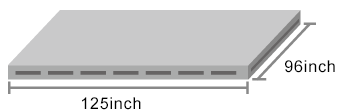
(1)96inch(243cm)Pallet ULD

img-96inch
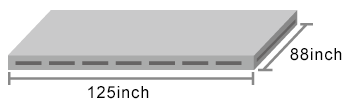
(2)88inch(223cm)Pallet ULD

img-88inch

*ULD: (Unit Load Devices) *Note: 1 inch = 2.54 cm

Generally speaking, the two ULDs listed above are the most standard ULDs used by airlines. Typically, decisions regarding loadability and freight rates are based on these ULDs. “96/88” refers to the external width of the ULD. The external length of the ULD, 125 inches, corresponds to the size of the pallet.

img-point
Quick Tip

Be careful if it exceeds about 200 cm!

Oversized and oversized cargo can be difficult to handle and may be subject to restrictions on shipping rates and routes.

Please contact us if your cargo exceeds 200 cm in length, as it may differ from standard-sized pallets.
Height and width of the cargo

img01

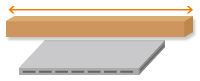
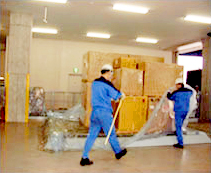
Typically, for ULDs used on aircraft, a net is placed over the cargo after loading to keep it secure (*).

The internal dimensions (length and width) measured from the inner edge of the fitting receptacles—which secure the individual tie-down fittings used to stretch the net—define the standard dimensions for checkable cargo.


*When placing the net, the cargo is secured tightly to prevent movement; therefore, when packing cartons and similar items, care must be taken to ensure that the corners on the outer edges do not become dented.
Height of cargo

img02

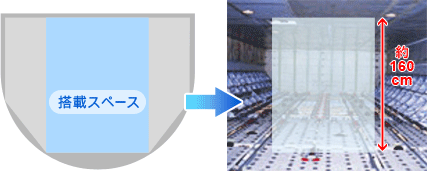
As mentioned above, just as there are standard base dimensions for aircraft cargo, there are also height restrictions. These are determined by the size of the aircraft’s cargo door and the specific loading area. As a general rule, items exceeding 160 cm in height cannot be carried on passenger flights and must instead be transported on dedicated cargo aircraft.
Installation location

Cargo Plane

img-kamotsu

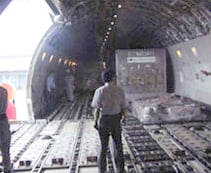
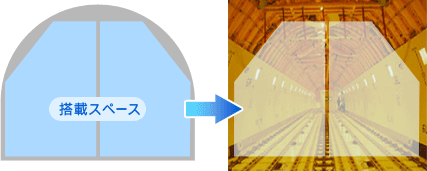
Due to their design, cargo-only aircraft are divided into the main deck and lower deck based on the location where cargo is loaded.

The main deck is typically the same area where passengers sit on passenger flights, and it is used as a dedicated cargo space. The upper portion of the aircraft has a “fish-shaped” profile, and since cargo is loaded while the ends of this section remain open, the height at those ends is inevitably limited.
Passenger Service / Cargo Service

img-ryokyaku

The lower deck is located beneath the aircraft, under the passenger seats on commercial flights. Since the aircraft has a rounded fuselage, both ends are tapered, just like the main deck.

Quick Tip

Up to 160 cm tall!

*If the luggage cannot be stowed in the overhead compartments of a standard-sized passenger aircraft, there may be restrictions on fares and itineraries.

Payload per pallet

When accepting air cargo, there are restrictions on both size and weight. Typically, cargo weight is categorized in detail based on where it is loaded onto the aircraft. Generally, the following weights serve as a guideline per ULD. These are determined by the aircraft type and specifications.

Approximate guidelines:
Lower Deck = Approximately 1,500.0–1,800.0 kg (96/88 in)
Main Deck = Approximately 2,000.0–3,000.0 kg (96/88 in)

Weight restrictions per package (cases requiring preparation for loading)

When loading cargo onto an aircraft, there is a specified maximum weight per unit area of the base (contact surface). This is referred to as the “floor load limit.” This limit varies depending on the aircraft model.

As a general guideline (for the B-747):
Lower Deck and Main Deck: approx. 970 kg/m²
Main Deck: approx. 1,950 kg/m² (special)

Furthermore, when loading within the ULD

When loading cargo onto a ULD, depending on the weight per package, the cargo must be secured (tied down) to prevent it from shifting inside the ULD. Special care must be taken with cargo weighing 1,100 kg or more.

Finally...

In recent years, as aircraft performance has improved, the types of aircraft used for cargo transport have become increasingly diverse, driven by the development of new models and upgrades to existing aircraft. The primary mission of aircraft operated by airlines is safe operation. Because aircraft accidents can cause significant damage, airlines will immediately halt all loading operations if there is even the slightest possibility of a factor that could compromise safety.
In air cargo transport as well, various checks and inspections are conducted prior to actual loading, and cargo is transported only after safety has been confirmed. Mitsui O.S.K. Logistics provides our customers with the know-how we have cultivated over many years regarding precautions for air transporting a wide variety of cargo, ranging from heavy cargo to other special cargo.
For inquiries regarding air transport, please contact a sales representative at Mitsui O.S.K. Logistics.

CARGO TRACKING