.png?width=2999&height=363&name=Mark%20MOL%20Logistics%20%20color%20large%20(4).png "Mark MOL Logistics color large (4)")
August 21, 2026
KDDI Corporation
Re-Teck Renewable Energy Solutions Co., Ltd.
Emulsion Flow Technologies Ltd.
MARKTEC Corporation
MOL Logistics Co., Ltd.
transcosmos Inc.
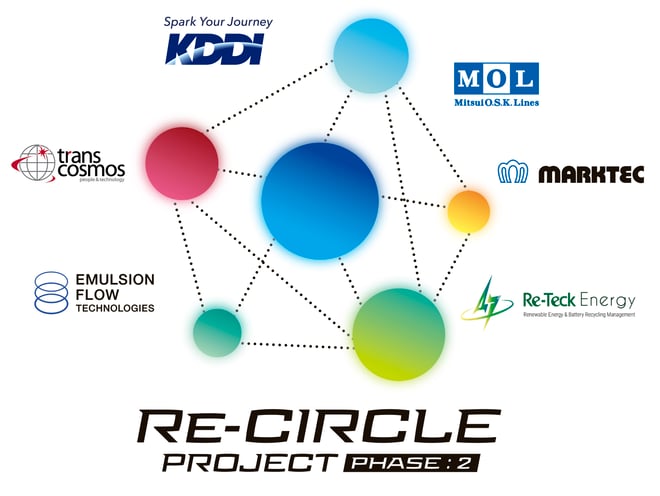
KDDI Corporation (Head Office: Minato-ku, Tokyo; President & CEO: Hiromichi Matsuda; hereafter KDDI), Re-Teck Renewable Energy Solutions Co., Ltd. (Head Office: Chiyoda-ku, Tokyo; President: Tomohiro Kasai; hereafter Re-Teck RES), Emulsion Flow Technologies Ltd. (Head Office: Naka, Ibaraki Prefecture; President & CEO: Hiroshi Suzuki; hereinafter EFT), MARKTEC Co., Ltd. (Head Office: Ota-ku, Tokyo; President & CEO: Keigo Nishimoto, hereafter MARKTEC), MOL Logistics Co., Ltd. (Head Office: Chiyoda-ku, Tokyo; President & CEO: Takashi Ito, hereinafter MOL Logistics), transcosmos Inc. (Head Office: Toshima-ku, Tokyo; Co-Presidents: Masaaki Muta and Takeshi Kamiya; hereinafter transcosmos) conducted a demonstration project (the “Demonstration”) to evaluate the performance of recycled battery materials and successfully validated battery performance comparable to that of batteries made from virgin resources using prototype batteries manufactured with recycled materials recovered from end-of-life lithium-ion batteries. This achievement represents a significant step forward toward realizing closed-loop recycling, in which materials recovered from spent batteries are reused as battery-grade materials for new batteries.
This demonstration was conducted under a collaborative framework that considered the entire supply chain necessary for the social implementation of resource circulation, including resource recovery and regeneration, performance evaluation, transportation, and traceability. The companies view used batteries not as "waste" but as "urban resources," aiming to build resource-circulating supply chains that are required both domestically and internationally.
The Demonstration forms part of the Re-CIRCLE Project, a six-company initiative focused on establishing collection and circular resource systems for lithium-ion batteries and advancing sustainable battery recycling.
In recent years, demand for lithium-ion batteries has grown rapidly, driven by the widespread adoption of smartphones, portable power banks, IoT devices, and electric vehicles (EVs). Lithium-ion batteries contain critical metals such as lithium, cobalt, and nickel, making resource circulation increasingly important from both supply security and environmental sustainability perspectives. Historically, however, recovering these valuable materials from end-of-life batteries has required significant cost and time. In addition, ensuring the quality needed for reuse in new battery materials has posed a major challenge, limiting the realization of closed-loop recycling in which recovered materials are returned to the battery supply chain.
In the Demonstration, cells recovered from end-of-life lithium-ion batteries were processed into high-purity black mass (1) using a low-environmental-impact recycling process. Rare metals were then extracted from the black mass through Emulsion Flow Technology(2) and reused in cathode materials to produce prototype batteries. Evaluation results confirmed that the recycled-material-based batteries delivered performance comparable to that of batteries manufactured from virgin resources across key performance indicators. The findings provide strong evidence of the commercial viability of recycled materials for use in next-generation battery production.
■ Key Results
- Successfully reused materials recovered from end-of-life lithium-ion batteries in the production of battery materials.
- Validated battery performance comparable to that of batteries made from virgin resources. Comprehensive testing, including electrode volume resistance, interfacial resistance, rate performance (3) across charge-discharge rates from 0.1C to 2C, and cycle performance (4), confirmed that batteries produced using recycled materials performed at a level equivalent to those manufactured using commercially available lithium carbonate.
■ Main Roles of Each Company in the "Re-CIRCLE Project"
|
Company Name |
Role |
|
KDDI |
Promoting the development and real-world implementation of a resource circulation model by leveraging collection channels for end-of-life mobile devices, including mobile phones and smartphones. |
|
Re-Teck RES |
Establishing a resource recovery process through the production of high-purity black mass from end-of-life lithium-ion batteries using a low-environmental-impact, non-calcination process. |
|
Emulsion Flow Technologies
|
Advancing the recovery and recycling of rare metals using Emulsion Flow Technology, contributing to resource circularity and reduction of environmental impacts. |
|
MARKTEC |
Material evaluation, quality assurance, and performance validation for battery applications utilizing recycled materials. |
|
MOL Logistics |
Evaluating logistics and supply chain requirements to support the transportation of recycled materials and the development of global circular supply chains. |
|
transcosmos |
Promotion of Trans-DX solutions for the development of circular economy and recycled-material supply chain infrastructure. |
■ Future Scenario
Based on the findings of this Demonstration, the participating companies will accelerate efforts to increase the collection of end-of-life lithium-ion batteries and further enhance and optimize battery materials produced from recycled resources. Looking ahead, the companies aim to enable the commercialization of batteries incorporating recycled materials and establish transportation and traceability systems aligned with applicable regulations and policy frameworks in Japan and international markets.
These achievements help establish an integrated battery recycling value chain, from the collection of end-of-life lithium-ion batteries through to their reuse as battery materials, contributing to resource security, lower environmental impact, and the advancement of a circular economy.
Note 1: Black mass is a black powder obtained by crushing and separating end-of-life lithium-ion batteries. It serves as a reusable intermediate material containing valuable metals such as lithium, cobalt, and nickel.
Note 2: The technology Emulsion Flow is a solvent extraction technology developed by EFT. Through its advanced separation and purification process, the technology enables the recovery of rare metals with lower cost, higher efficiency, and higher purity compared with conventional technologies.
TECHNOLOGY | Emulsion Flow Technologies
Note 3: Rate capability refers to a battery's charge and discharge performance at different current levels (C-rates).
Note 4: Cycle performance refers to the durability of a battery, as evaluated through repeated charge-discharge cycling tests.
Inquiries regarding this matter
MOL Logistics Co., Ltd. Sales Strategy Department, Public Relations
E-mail: mlgjp_inquiry@molgroup.com